Landscaping a Steep Side Yard in Sugar Hill
A steep side yard can quietly become one of the biggest problem areas on your property. In Sugar Hill, many homes are built on sloped lots where the narrow space between houses drops sharply from front to back. What looks like a simple strip of grass often turns into erosion, standing water, foundation concerns, and an area that is difficult or unsafe to maintain.
At Razor Sharp Lawns, we treat steep side yard landscaping as a structural and drainage project first, and a planting project second. In Northeast Georgia’s clay soil, water control determines whether a slope stabilizes or continues to wash out year after year. Simply adding mulch, sod, or decorative stone without correcting grading and drainage will not solve the underlying issue.
This guide explains when structural solutions are necessary, how we stabilize steep side yards in Sugar Hill, and how we integrate grading, retaining walls, and drainage systems into functional, low-maintenance designs. It will also help you understand budgeting considerations using our Landscape Pricing Guide.
Why steep side yards become problem zones
Side yards are naturally confined spaces. When a slope exists in that narrow corridor, water has nowhere to spread out. Instead, it accelerates downhill, often carving channels along the foundation or fence line.
In Sugar Hill, red clay soil compounds the issue. Clay does not absorb water quickly. During heavy rain, runoff remains on the surface, increasing speed and erosion potential.
Common side yard problems we see:
-
- Erosion trenches forming after storms
- Grass thinning or sliding downhill
- Exposed tree roots
- Muddy low spots near the backyard
- Water pooling against the foundation
- Difficulty mowing safely on steep grades
Because side yards are less visible from the street, homeowners sometimes delay fixing them. Unfortunately, erosion often worsens quietly until structural damage or drainage problems become unavoidable.
Step 1: Analyze slope angle and water movement
Every successful side yard project begins with a detailed site evaluation. Not all slopes require retaining walls. Some can be corrected with grading and drainage alone.
We assess:
-
- Slope steepness and total elevation change
- Length of runoff path from front to back
- Roof downspout discharge locations
- Neighboring property runoff contributions
- Soil compaction and stability
Often, we discover that concentrated roof runoff is the main contributor. Redirecting that water underground can significantly reduce erosion pressure.
When simple grading is enough
If the slope is moderate and soil remains relatively stable, reshaping the grade may be sufficient.
Grading improvements may include:
-
- Re-sloping the surface to distribute runoff evenly
- Creating shallow swales to guide water safely
- Filling eroded trenches and compacting soil properly
- Establishing stabilized planting beds
However, grading alone cannot fix steep or highly eroded slopes. In many Sugar Hill properties, the angle and water force require structural reinforcement.
When terracing becomes the better solution
If the slope is too steep to mow safely or continues to erode despite drainage improvements, terracing may be the most reliable option.
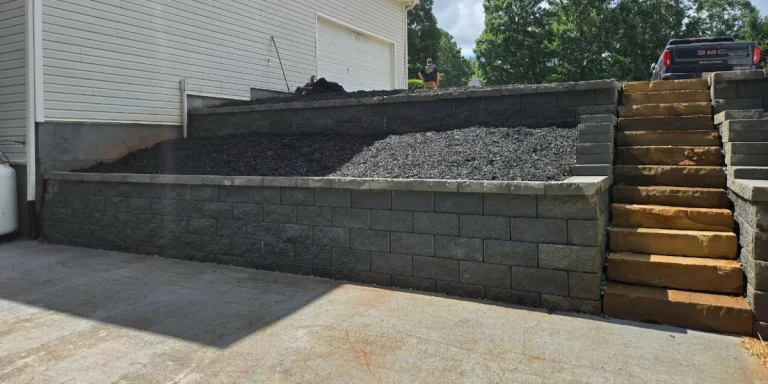
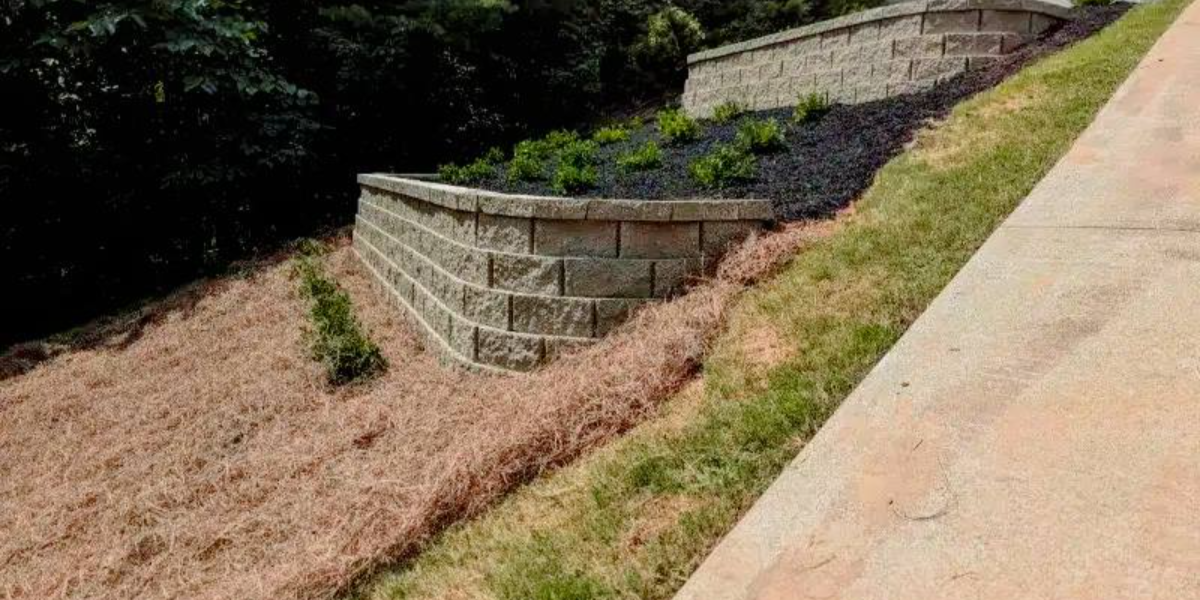
Terracing breaks one long incline into multiple shorter levels supported by retaining walls. This reduces water speed and creates usable, stable space.
Benefits of terracing a side yard:
-
- Shortens runoff paths and reduces erosion
- Improves access between front and backyard
- Creates defined planting tiers
- Reduces maintenance demands
- Stabilizes soil long term
Each terrace must include proper base preparation, gravel backfill, and drainage pipe to prevent hydrostatic pressure buildup.
Retaining walls for structural stability
On steeper Sugar Hill side yards, engineered retaining walls provide long-term support.
We build walls with:
-
- Deep excavation below grade
- Compacted crushed stone base
- Angular gravel drainage zones
- Perforated drain pipe at the base
- Geogrid reinforcement for taller structures
Skipping drainage behind retaining walls is one of the most common causes of leaning and failure. Water must be collected and discharged properly to protect the structure.
Integrating drainage into narrow side yards
Drainage is especially important in confined spaces. Because side yards funnel runoff, we frequently install subsurface systems.
Common drainage solutions include:
-
- French drains along the slope
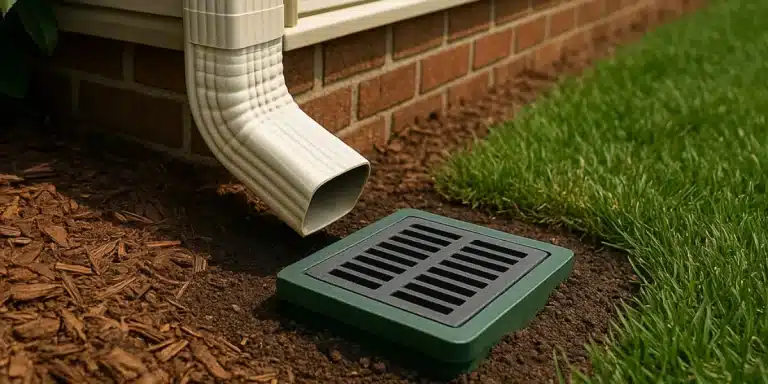
- Catch basins at low points
- Buried downspout extensions
- Surface swales to guide runoff
These systems reduce water pressure before it can cut through soil or undermine walls.
Creating safe access through the side yard
Many homeowners use side yards for access between front and backyard spaces. On steep grades, that access can feel unsafe.
We often incorporate:
-
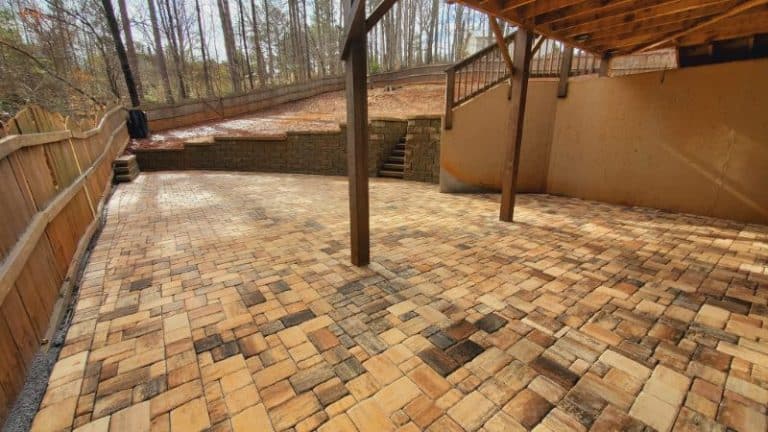
- Paver walkways installed over compacted base
- Integrated stone steps within terraces
- Wider landings for stability
- Low retaining borders to define pathways
Proper installation ensures walkways remain level and do not shift due to soil movement.
Planting strategies for long-term stabilization
After structural and drainage corrections, plantings help anchor soil.
Effective slope plantings include:
-
- Deep-rooted shrubs that bind soil
- Groundcover plants to reduce exposed areas
- Layered plantings for visual depth
- Mulch or decorative stone for surface protection
Plant roots stabilize soil, but they must be paired with proper drainage to succeed.
Reducing maintenance on steep slopes
One major goal of side yard landscaping is lowering maintenance demands. Steep grass requires careful mowing, which increases safety risks.
By replacing steep turf with terraces, plant beds, or stabilized groundcover, homeowners reduce:
-
- Mowing hazards
- Repeated erosion repair
- Soil washout after storms
- Weed overgrowth in unstable areas
Low-maintenance solutions are especially important in narrow areas that are difficult to access with equipment.
Common mistakes homeowners make
DIY slope corrections often overlook structural and drainage demands.
Frequent problems include:
-
- Stacking decorative blocks without base preparation
- Installing shallow drainage pipe that clogs
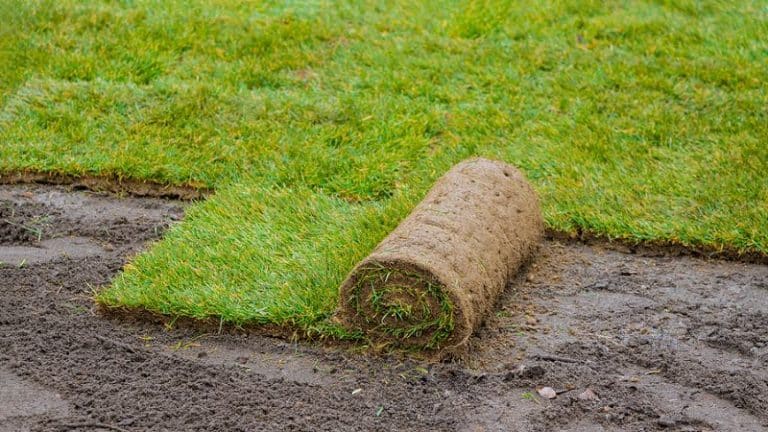
- Planting sod on slopes without stabilization
- Ignoring roof runoff contributions
Correcting failed slope work is typically more expensive than building it properly from the beginning.
Understanding the investment
Side yard landscaping costs depend on slope severity, retaining wall height, drainage complexity, and site access.
Key cost factors include:
-
- Excavation depth and soil removal
- Length and height of retaining structures
- Drainage system installation
- Material selection for walls and walkways
Homeowners planning side yard improvements often review our Landscape Pricing Guide to better understand how structural requirements influence overall budgeting.
Addressing slope instability early usually costs less than repairing erosion damage later.
Areas We Serve
Razor Sharp Lawns provides slope stabilization, retaining wall construction, drainage installation, and full landscape design throughout Northeast Georgia, including:
• Sugar Hill
• Buford
• Braselton
• Hoschton
• Jefferson
• Auburn
• Surrounding areas
We build durable landscapes designed for Georgia’s clay soil and heavy rainfall.
Ready to stabilize your steep side yard in Sugar Hill?
Turn erosion into a long-term solution
If your side yard is eroding, unsafe to maintain, or simply underutilized, a professional evaluation can identify the right structural and drainage solution.
Contact Razor Sharp Lawns today to schedule your consultation or request an estimate. We will assess your slope, water flow, and access needs to design a stable, low-maintenance side yard built to last.